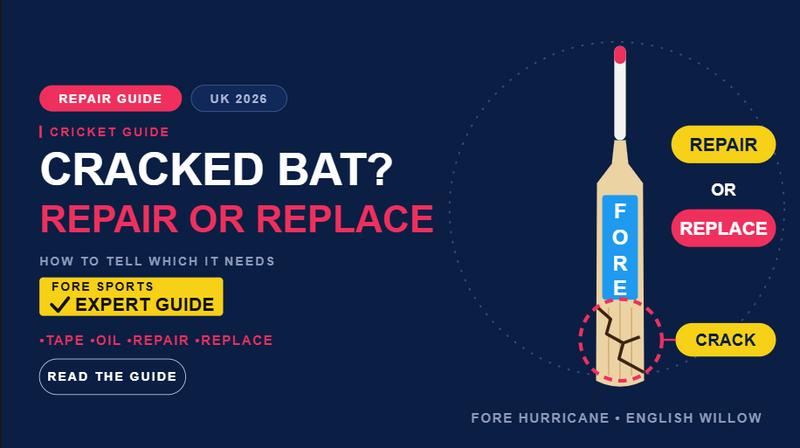
The last match is done, the whites are washed, and the bat goes back in the bag until spring. That is exactly how bats end up cracked by April. To store a cricket bat over winter, wipe it clean, let it dry naturally, oil bare willow only lightly, and keep it indoors in a cover, somewhere cool, dry and away from radiators. Avoid garages, lofts and car boots.
Why Cricket Bats Dry Out (and Go Damp) in Winter
English willow is a natural material that takes on and gives off moisture depending on the air around it. In summer that is not a problem, because the bat is in use and the conditions are fairly steady. Winter in the UK is different, and it can hurt a bat in two opposite ways.
- Too dry. Central heating, radiators and direct sunlight pull moisture out of the surface fibres. Dry willow becomes more brittle, grain lines become more visible, and small surface cracks are more likely when you hit a hard ball again in spring.
- Too damp. A cold garage, a shed, a damp kit bag or a cupboard on an external wall can leave the wood softer and easier to dent. Damp can also lift edge tape, toe guards and facing sheets, and it encourages mould.
The real problem is usually swings rather than either extreme. A bat that spends a week in a cold car boot, then a week next to a radiator, is being asked to adjust again and again. Most winter damage is slow and cumulative, which is why a steady storage spot matters more than any clever treatment.
Where to Store a Cricket Bat Over Winter
The best spot is somewhere indoors that stays at a fairly steady, moderate temperature. A useful test: if you wouldn't leave a guitar or a good piece of wooden furniture there for four months, don't leave your bat there.
| Where | Verdict | Why |
| Wardrobe or cupboard in a lived-in room | Best choice | Steady temperature, away from direct heat |
| Spare room (heated, not hot) | Good | Fine if it isn't freezing or beside a radiator |
| Under the stairs or utility room | Use with care | Can hold damp air or swing in humidity |
| Against a cold external wall | Avoid | Condensation forms on cold walls in winter |
| Garage or shed | Avoid | Big temperature swings, often damp |
| Loft | Avoid | Swings from cold to warm, hard to control |
| Car boot | Avoid | Temperature swings, moisture, and the bat gets forgotten |
| Next to a radiator or sunny window | Never | Heat and sun dry the blade out |
If you want to be precise, a cheap hygrometer will tell you how humid the room is. As a general guide for wooden items, many people aim for roughly 40–60% relative humidity, but this is general woodworking advice rather than a cricket-specific rule, and a sensible indoor room usually gets you close without any gadgets.
How to Prepare Your Bat Before Winter Storage
Preparation matters as much as where the bat sits. Spend ten minutes on this before the bat goes away.
- Wipe it down. Use a clean, dry cloth on the face, edges, back and toe to remove mud, dust and moisture. Grit left against the wood and tape can wear it and trap damp.
- Let it dry naturally. If the bat has been out on a damp outfield, leave it at room temperature until it is fully dry. Don't use a radiator, hairdryer or fire to speed it up. Never put a damp bat into a cover or bag.
- Inspect it properly. Check the edges, toe, shoulders and splice for new cracks, and look at the face for raised or rough areas. Our guide to what to do about a cracked cricket bat explains which cracks are cosmetic and which need a specialist. Winter is a good time to get repairs done, because workshops are quieter than in peak season.
- Check the protection. Look at edge tape, the facing sheet and the toe guard. If any of them are lifting, peeling or bubbling, fix or replace them now, because lifted tape lets in grit and moisture.
- Check the handle and grip. Look for a loose splice, a creaking handle or loose binding. These are easier to deal with before the season than in the middle of it.
- Oil only if needed. See the next section.
- Decide whether it needs a refurbishment. A heavily used bat can benefit from an end-of-season clean-up, which removes old facing, sands the blade, repairs cracks and fits a fresh grip. A bat with fresh protection is far easier to put away and forget.
Should You Oil Your Cricket Bat Before Winter?
This is where advice varies, and it confuses a lot of players. Some UK makers recommend a light oiling before the close season, while others warn that over-oiling is a common winter mistake. Both are right. It depends on the bat.
Oil lightly if:
- The bat has bare willow on the face, edges or back (no facing sheet).
- The wood looks pale, thirsty or rough.
- You haven't oiled it since the start of the season.
Skip it, or keep it to the edges and back, if:
- The face has a facing sheet and the wood underneath is protected.
- The bat already looks and feels healthy, or was oiled recently.
- The bat feels heavy or the face looks dark and soft.
How to do it properly:
- Use raw linseed oil sold for cricket bats. Don't use boiled linseed oil, cooking oil or other household oils.
- Put a few drops on a clean, soft cloth and wipe a thin, even layer over the bare willow on the face, edges and back. Avoid the stickers, the splice and the handle.
- Lay the bat flat overnight so the oil can soak in.
- Next day, wipe off any surface oil before the bat goes into its cover.
More oil is not better. Too much softens the willow and adds weight, and in cool conditions oil can stay tacky for longer. Oil also can't fix a damp storage spot. If the room is wrong, move the bat rather than adding more oil.
If you oil only once a year, don't oil again mid-winter unless you spot genuinely dry wood during a check.
Covers, Bags and Position
Use a breathable, padded cover. A good cover protects the bat from dust and knocks in a cupboard. Look for ventilation, because a sealed cover traps moisture. The Fore Sports bat cover is described as padded over the face, edges and toe with a breathable lining. You can find out more about choosing the right size on our cricket bat protection page.
Don't wrap the bat in plastic. Cling film, bin bags or sealed plastic cases trap moisture and can encourage mould and lifting tape over a few months.
Empty and air your kit bag first. A damp bag can be a source of moisture all winter. If you do keep the bat in a kit bag, make sure the bag is clean and dry, and store it indoors, not in the garage. Keeping damp pads and boots in the same bag as the bat is a recipe for trouble. If you want to use silica gel sachets, use them sparingly, since the aim is a stable environment rather than bone-dry wood.
Lie it flat or stand it upright. Store the bat flat on a shelf or standing upright in its cover, with nothing stacked on top. Avoid leaning it at an angle against a wall for months, because it can slowly pick up a bend or end up against a cold external wall.
A Simple UK Winter Storage Timeline
| When | What to do |
| Last match or net of the season (September–October) | Wipe down, dry naturally, inspect, fix tape and toe guard, oil lightly if bare |
| Within the week | Cover on, bat in a stable indoor spot, bag emptied and aired |
| Mid-winter (December–January) | One quick check: look for lifting tape, new cracks, a musty smell |
| Late winter (February–March) | Check again, book any repairs, order replacement grip, tape or facing |
| Pre-season (March–April) | Wake the bat up gently (see below) |
You don't need to check weekly. Twice is enough, and the aim is simply to catch problems early.
Signs Your Bat Has Dried Out or Got Damp
It may have dried out if:
- The face looks pale, dull or rough, and the grain feels raised.
- More fine lines are visible than at the end of the season.
- The edges feel brittle or have small splinters.
It may have got damp if:
- There is a musty smell from the cover or bag.
- You see mould spots, or the wood looks dark or stained.
- Tape or facing is lifting or bubbling.
- The blade feels soft or looks swollen.
If you see mould or damp, clean gently, let everything dry naturally in a stable room, and refresh the protection. Don't reach for heavy oiling, because oil won't fix damp and can make it harder for new tape to stick. If the wood is swollen, soft or has opened up, get it looked at by a specialist before you use it.
Bringing Your Bat Back in Spring
Treat the bat as if it has been resting for months, because it has.
- Inspect it again. Check the edges, toe, face, splice and handle, and any facing or toe guard.
- Fix anything lifting. Replace peeling tape, a loose toe guard or a worn grip before you play.
- Ease it back in. Start with gentle throwdowns or soft-ball sessions before facing a hard, fast ball. You are not knocking in a new bat, but you are letting the fibres get used to impact again.
- Listen and feel. A rattle, a new sting through the hands or a different sound off the face means stop and get it checked.
If your bat has dried out noticeably, a light oil and a gentle session with a mallet can help, but don't try to force it. A properly prepared bat with a good facing sheet and toe guard is much less likely to have problems in the first place.
What If You Play Winter Nets or Indoor Cricket?
Many club players keep batting through winter. If you use your bat in indoor nets:
- Use an older bat for indoor sessions and keep your best match bat for the summer.
- Check it after each session, as hard indoor floors are tough on the toe.
- Let it adjust gradually when moving from a cold car to a warm sports hall, rather than leaving it in the boot between sessions.
- Wipe it down and let it dry before it goes back in the bag.
Does the Type of Willow Matter?
The same principles apply to every bat. English willow is softer and more responsive, so it feels changes in moisture more and benefits most from careful storage. Kashmir willow is denser and generally lower-maintenance, but it still shouldn't be left damp or next to a radiator. If you are replacing a damaged bat, you can browse English willow cricket bats or the full cricket bat range at Fore Sports.
Conclusion
You don't need special equipment to get a bat safely through winter. Clean it, dry it, check it, oil it only if it needs it, and then choose a spot you would trust for any good piece of wood. A steady cupboard beats the best oil in the wrong place, and a bat that starts spring in good shape is one you can trust when the first hard ball arrives.