Buying your first English willow cricket bat is confusing, mostly because "beginner" covers such different people. A nine-year-old picking up a bat for the first time, a fourteen-year-old moving into hard-ball club cricket, and an adult switching over from tape-ball games all need different things - even though they're all technically beginners.
This guide cuts through that. It explains what actually matters when choosing an English willow cricket bat for beginners - size, weight and pickup, willow grade, and budget - and where relevant, points to specific options from Fore Sports' English willow range so you can see how the advice applies in practice.
Quick Answer: Are English Willow Cricket Bats Good for Beginners?
Yes, with a caveat. English willow is the standard material for hard-ball cricket at club, school and academy level, and there's no rule saying beginners should avoid it. A well-fitted English willow bat will usually feel better and last longer than an equivalent Kashmir willow bat, because English willow is lighter for its size and has better natural performance.
The caveat: English willow costs more, and a beginner doesn't need the most expensive grade of it. The best English willow bat for a beginner is one that's the right size, has a pickup the player can control, and fits a sensible budget - not necessarily the bat with the flashiest grain pattern or the highest price tag.
If you're buying for someone still playing softball, tape-ball, or purely casual garden/net cricket with no plans to move into hard-ball club cricket soon, Kashmir willow is worth considering instead - more on that below.
Our Beginner-Friendly English Willow Bat Picks
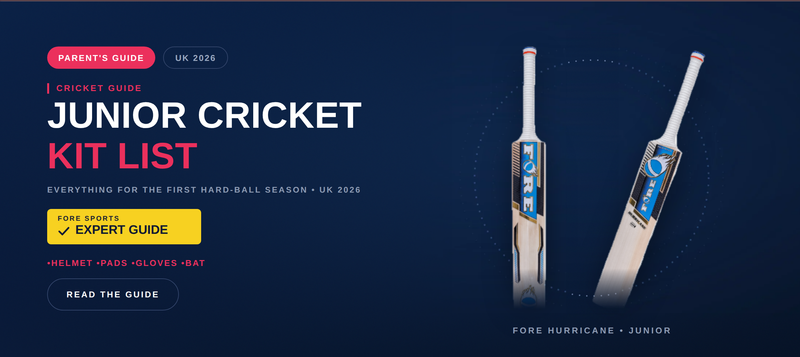
Fore Sports currently stocks two English willow ranges aimed at junior and youth players moving into serious hard-ball cricket: Hurricane and Tornado. Both ranges run across Size 4, Size 5, Size 6 and Harrow, covering younger juniors through to older juniors and smaller-framed players stepping up toward senior cricket.
It's worth being upfront here: this collection is junior and youth-focused. If you're an adult beginner needing a full senior (Short Handle) bat, the Harrow size is the closest fit available, aimed partly at smaller-build adults - but it isn't a substitute for a full senior blade if you need maximum length and a bigger swell.
| Range | Sizes available | Willow grade | Key advantage | Price |
| Hurricane | Size 4, Size 5, Size 6, Harrow | Grade A stated for Harrow; other sizes described as "properly graded" or "higher-grade" English willow without a specific grade listed | Balanced pickup, generous sweet spot, cane handle designed to reduce vibration | £229 (list price £275) |
| Tornado | Size 4, Size 5, Size 6, Harrow | Premium Grade 1 English willow confirmed for Size 4 and Size 5; grade not specified on the Size 6 and Harrow product pages | Fuller/pro-shaped profile on the larger sizes, powerful sweet spot, light junior-friendly pickup | £249 (list price £300) |
Two things to check directly with Fore Sports before buying, since neither is stated on the product pages: exact bat weight and pre-knocked/preparation status. Neither range specifies a weight in grams or ounces, and neither confirms whether the bat arrives pre-knocked and ready for light use or needs full preparation from raw. Don't assume either way - ask before you buy, especially if you want to start using the bat quickly.
You can browse the full English willow cricket bat collection to compare current sizes and pricing directly.
What Makes a Good Beginner Cricket Bat?
Five things determine whether a bat actually suits a beginner, in roughly this order of importance:
- Size - matched to height and reach, not just age
- Pickup - how the weight feels in your hands when you lift and swing, not just the number on the scale
- Profile and sweet spot - where the bat performs best, and how forgiving it is on mishits
- Willow grade - mostly a cosmetic and pricing factor, not a performance guarantee
- Budget - what you're comfortable spending on a bat that a beginner will likely outgrow or need replacing as their game develops
Notice that grade and price sit near the bottom, not the top. Retailers often lead with grade because it's an easy way to justify a higher price. For a beginner, fit and control matter far more.
English Willow vs Kashmir Willow for Beginners
This is the first real decision, and it depends entirely on what kind of cricket you're playing.
| English Willow | Kashmir Willow | |
| Weight for size | Lighter, easier to generate bat speed | Heavier for the same size |
| Performance | Better ball response ("ping"), softer feel off the bat | Denser, harder feel, generally less responsive |
| Durability | Needs proper knocking-in and care; can be more prone to damage if mistreated | More durable against knocks, more forgiving of poor maintenance |
| Price | Higher | Significantly lower |
| Best suited to | Hard-ball club, school and academy cricket | Tape-ball, softball, casual garden cricket, or players testing whether they'll stick with the sport |
| Standard at UK club level | Yes | Rarely used in serious hard-ball matches |
If you or your child are about to start (or have just started) hard-ball club or school cricket, English willow is the sensible choice - it's what the format is built around. If you're playing tape-ball or casual cricket with no immediate plans to move to hard-ball, or you genuinely don't know yet whether the sport will stick, a Kashmir willow bat is a reasonable, lower-cost way to start without much downside.
What English Willow Grade Should a Beginner Buy?
Willow grading is one of the most misunderstood parts of buying a bat, so it's worth being precise about what it actually means.
Grade is mostly about appearance and consistency, not guaranteed performance. Higher grades typically have straighter, more visible grain lines and fewer blemishes. This looks better and often correlates with slightly better willow, but it isn't a direct measure of how the bat will perform - two bats of different grades cut from the same tree can perform very similarly.
- Grade 1 willow generally has the straightest grain and cleanest appearance, and commands the highest price. It doesn't automatically mean the bat will hit the ball dramatically better than a lower grade.
- Grade 2 and Grade 3 willow has more visible blemishes or less uniform grain, but is still genuine English willow with the same core performance characteristics. This is often the better-value choice for a beginner.
- Grade A (as used on Fore Sports' Hurricane Harrow model) sits within this same general grading logic - it refers to the quality tier of the willow selected, rather than a separate international standard.
For a complete beginner or junior player, a mid-range grade is a sensible starting point - you're paying for genuine English willow and decent cosmetics without paying a premium purely for the straightest grain pattern. For a serious club player or someone who already knows they'll stick with the game, paying more for a higher grade becomes a more reasonable choice, partly for performance consistency and partly because they'll get more playing hours out of the investment.
On the current Fore Sports range: Tornado states Premium Grade 1 English willow on the Size 4 and Size 5 pages specifically. Grade isn't specified on the Tornado Size 6 or Harrow pages, or on most of the Hurricane range beyond the Harrow model's "Grade A" listing. If grade is a deciding factor for you, it's worth confirming the specific grade for the exact size you're considering before buying.
What Cricket Bat Size Should a Beginner Use?
Size should be based primarily on height and reach, not age alone - two nine-year-olds can need different sizes depending on build. Use age as a rough starting point, then check the height range and, ideally, let the player hold the bat before buying.
| Size | Typical height guide | Typical age guide | Notes |
| Size 4 | Shorter junior players | Around 8–10 | Lightest pickup in junior range; good for younger beginners developing basic technique |
| Size 5 | Taller than Size 4 players | Around 9–11 | Common step-up size for juniors progressing in club or school cricket |
| Size 6 | Approximately 4'9"–5'0" | Around 10–12 | Bridges toward senior-length bats; suited to older juniors in serious junior or academy cricket |
| Harrow | Taller juniors and some smaller-build adults | Typically 14–17 | Closest size in this range to a senior bat; used as a transition size before full senior bats |
A general rule if you're between two sizes: go with the size that lets the player hold a comfortable stance without the bat feeling like a stretch to control, rather than sizing up "to grow into." A bat that's too big undermines technique far more than a bat that needs replacing again in a year or two.
Compare junior sizing directly: Size 4, Size 5, Size 6, and Harrow in the Tornado range, or the equivalent Hurricane sizes.
What Weight Should a Beginner Cricket Bat Be?
This is where most buying guides give bad advice by quoting a specific weight in ounces and telling every beginner to aim for it. The truth is more useful and less tidy: static weight matters far less than pickup.
Static weight is simply what the bat weighs on a scale. Pickup is how heavy the bat feels when you lift it and bring it through a shot - and it depends on where the weight sits, not just how much of it there is. Two bats with identical weight can feel completely different depending on:
- Weight distribution - a bat with more wood concentrated toward the middle of the blade can feel lighter through the swing than a bat with the same weight spread evenly
- Spine and swell position - where the bat's thickest point sits along the blade affects balance
- Profile - a bat with a fuller profile can carry more wood without feeling heavier in the hands
- Handle - handle stiffness and length affect how the weight transfers through the shot
For a beginner, the priority is a bat they can control through a full, correct shot - not the heaviest bat they can physically lift. A beginner struggling to control a heavy bat will develop poor technique to compensate, which is harder to correct later than simply moving to a lighter bat sooner.
Neither the Hurricane nor Tornado range states an exact weight on the product pages, which is worth knowing before you buy. If weight is important to you - and for most players it should be - contact Fore Sports directly to confirm the weight for the specific size you're considering, or ask whether bats can be weighed before dispatch.
What Bat Profile and Sweet Spot Should Beginners Choose?
Sweet spot is the area of the blade that produces the best results on contact. Its position varies by bat design:
- A mid sweet spot is the most versatile and generally the easiest for a beginner to work with, since it responds well across a range of shot types and doesn't require precise timing to find it consistently.
- A low sweet spot can suit players who get onto the front foot early and drive through the ball, but is less forgiving on shots played from further back.
- A high sweet spot tends to suit taller players or those who play more off the back foot, but again requires more consistent timing to use effectively.
Profile refers to the overall shape of the blade - how full, how bowed, and how the edges are distributed. A fuller profile with a more generous edge can make mishits more forgiving, which genuinely helps a beginner still developing consistent timing. A slimmer, more traditional profile can feel more precise in experienced hands but is less forgiving early on.
On Fore Sports' range, the Tornado Size 6 is described as having a "pro-shaped profile" that's slightly fuller than the Size 5, while the Harrow sizes in both ranges are described as having a more versatile, pro-shaped profile suited to a fuller range of shots. Neither range specifies exact edge measurements, so if profile depth matters to you specifically, it's worth asking for that detail directly.
Should Beginners Buy a Pre-Knocked Cricket Bat?
Neither the Hurricane nor Tornado product pages confirm whether the bats arrive pre-knocked. Both describe the blade as "professionally pressed, sealed and polished," and one page describes a bat as "ready to play out of the cover" - but that phrasing shouldn't be assumed to mean the bat has been fully knocked in. Pressing and sealing are manufacturing steps that happen before a bat leaves the factory; knocking-in is preparation that typically still needs to happen, or be completed, before full-power hitting with a hard ball.
If preparation status matters to your timeline - for example, you need the bat ready for a match soon - confirm directly with Fore Sports whether a given bat is pre-knocked, partially prepared, or needs full knocking-in before use.
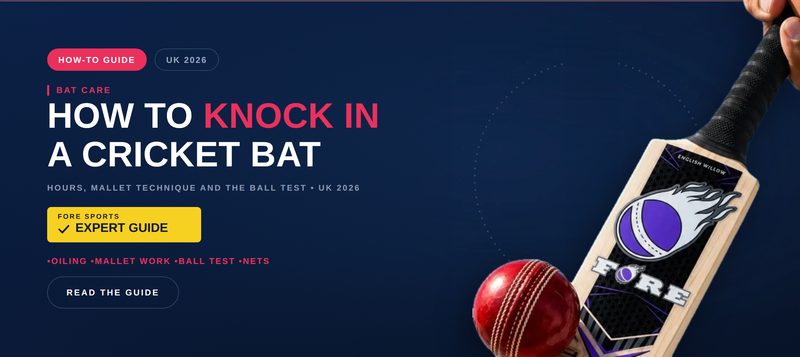
What knocking-in actually does: it compresses the willow fibres at the surface of the blade, particularly on the edges and toe, so the bat can withstand the impact of a hard cricket ball without cracking prematurely. Skipping or rushing this step is one of the most common ways beginners damage a new bat.
General principles, without specific timeframes (which vary by bat and shouldn't be treated as a fixed number of hours regardless of source):
- Start with a proper cricket bat mallet, not a random hard object
- Begin with lighter taps and gradually increase force as the surface compresses
- Focus on the edges and toe before hitting through the middle
- Use old, softer balls before moving to new match balls
- Avoid full-power net sessions with a brand-new ball until the bat has had proper preparation time
If a bat is confirmed pre-knocked, it will usually still benefit from some light preparation before full-intensity match use - pre-knocked doesn't always mean zero further preparation is needed, so it's worth asking what "pre-knocked" specifically covers for that product.
How Much Should You Spend on an English Willow Cricket Bat?
There's no single "correct" beginner budget, but a few general patterns hold across the UK market:
- Entry-level English willow bats tend to sit at a noticeably lower price than higher-grade, higher-spec bats, reflecting differences in willow grade, finishing and brand positioning rather than a guarantee of dramatically different performance for a beginner.
- Junior bats are generally priced lower than senior/adult bats of an equivalent grade, partly due to less material and lower manufacturing costs for smaller blades.
- Spending more doesn't automatically mean a better fit - a beginner in the wrong size or with a pickup they can't control won't benefit from a higher grade of willow.
As a practical approach: decide your size and comfortable pickup first, then compare options within that size at different price points, rather than starting from a target price and working backwards. On Fore Sports' current range, both the Hurricane (£229, reduced from £275) and Tornado (£249, reduced from £300) sit at the same price across all four junior sizes within each range, which makes size and grade - rather than price - the main differentiator between them for a given player.
Common Cricket Bat Buying Mistakes Beginners Make
- Buying a size "to grow into." A bat that's too long or heavy undermines technique more than it saves money in the long run.
- Assuming a higher grade automatically means a better-performing bat. Grade is mostly cosmetic; fit and pickup matter more for a beginner.
- Skipping or rushing knocking-in. This is one of the most common causes of early bat damage, particularly cracking near the toe or edges.
- Choosing weight by number alone. A bat's static weight tells you very little about how it will actually feel in a shot - pickup is what matters.
- Using the wrong ball too early. Hitting a new bat hard with a full-weight match ball before it's properly prepared risks damage.
- Ignoring maintenance. Storing a bat somewhere damp, or leaving it unprotected in a bag, shortens its usable life regardless of quality.
- Not checking pre-knocked status before buying. If you need a bat ready quickly, confirm preparation status rather than assuming.
Best English Willow Cricket Bat for Different Beginners
If you're buying for a younger junior just starting hard-ball cricket - Size 4 in either range is the starting point; check height against the size guide above before committing, and confirm weight directly with Fore Sports if your child is on the smaller side even for that size.
If you're buying for an older junior in serious school, club or academy cricket - Size 6 is designed to bridge toward senior cricket, with a fuller profile intended to handle a wider range of shots against faster bowling.
If you're buying for a teenager or smaller-build adult transitioning toward senior cricket - the Harrow size in either range is the closest fit in this collection, though it's worth trying a full senior bat too if you have the option, since Harrow is a transition size rather than a direct senior replacement.
If you're moving from Kashmir willow to English willow for the first time - expect the bat to feel noticeably lighter for its size and more responsive off the middle; this is normal and part of what you're paying the extra cost for. Don't be tempted to size up to compensate for the lighter feel - the size guide above should still be your primary reference.
If you're working to a firm budget - within this collection, the Hurricane range is the lower-priced option at every size compared to Tornado, without a stated difference in willow origin (both are full English willow); the main documented differences are in grade transparency (Tornado states Grade 1 for Size 4/5) and profile description.
If you want a fuller profile aimed at more shot-power once technique is established - the Tornado range's Size 6 and Harrow, described with a "pro-shaped" and "fuller" profile respectively, are worth comparing against the equivalent Hurricane sizes.
How to Look After Your English Willow Cricket Bat
- Knock in properly before full use, as covered above, even if the bat is described as pre-knocked - confirm what preparation has already been done.
- Oil the bat only if it isn't pre-oiled or treated, and avoid over-oiling, which can affect performance; check the specific guidance for your bat before applying anything.
- Protect the toe. The toe is one of the most common failure points - a toe guard or careful storage away from hard surfaces reduces the risk of splitting.
- Store it somewhere dry. Damp conditions are one of the fastest ways to damage English willow; avoid leaving a bat in a damp bag, shed, or car boot for extended periods.
- Use an appropriate ball for the bat's preparation stage. Don't hit new match balls at full power with a bat that hasn't been properly knocked in.
- Check regularly for cracks, particularly around the edges and toe, and stop using a bat that shows signs of significant damage until it's been assessed - continuing to use a cracked bat risks it failing completely, sometimes dangerously, during a shot.
- Use a bat cover for transport and storage to reduce knocks and moisture exposure between uses. Fore Sports stocks a bat cover that fits this purpose.
Conclusion
For most UK beginners moving into hard-ball cricket, a properly sized English willow bat with a pickup they can control is the right choice - the willow grade and price tag matter far less than getting size, weight and profile right for the individual player. Within Fore Sports' current junior and youth range, Size 4 through Size 6 covers younger to older junior players, while Harrow serves as a transition size for older teenagers and smaller-build adults stepping toward senior cricket.
Whatever size and range you're considering, confirm weight and preparation status directly before buying if either matters to your timeline, and prioritise fit over spec sheet. You can explore the full English willow cricket bat collection at Fore Sports to compare current sizes, pricing and range side by side.