A good kit bag is the most overlooked piece of cricket equipment you own. You will spend hours choosing a bat and comparing pads, then carry all of it in a bag you barely thought about. That bag is what keeps a few hundred pounds of gear dry, protected and organised, week after week, in weather that rarely cooperates.
This guide covers everything you need to choose a cricket kit bag that lasts: the features that actually matter, why a black kit bag is a smart pick, how to match a bag to the way you play, and our top recommendations from the Fore Sports range. Whether you are kitting out for league cricket or replacing a bag that gave up mid-season, you will leave knowing exactly what to buy.
Table of contents
- Why choosing the right cricket kit bag matters
- Cricket kit bag types explained
- Key features to look for in a kit bag
- Why choose a black kit bag?
- How to choose your ideal cricket kit bag
- Top recommended cricket kit bags
- How to pack a cricket kit bag efficiently
- Care and maintenance tips
- Frequently asked questions
- Final thoughts
Why choosing the right cricket kit bag matters
Add up a senior cricket kit and the numbers climb fast. A decent English willow bat alone can cost more than the rest of your gear combined, and once you factor in a helmet, batting pads, gloves, shoes and protective equipment, your bag is carrying a serious investment.
A quality cricket kit bag earns its place in three ways.
- It protects your gear. Padded walls and a structured base stop bats knocking against helmets and pads getting crushed in a car boot. A weak bag transfers every bump straight to your equipment.
- It saves you time. Dedicated compartments mean you are not turning the bag inside out in the changing room looking for a glove while the umpire calls you in. Everything has a place.
- It lasts. A cheap kit bag tends to fail in the worst way: a split seam or a snapped handle on a wet Saturday with a full load inside. Spending sensibly once is cheaper than replacing a bag every season.
Get the bag right and it quietly does its job for years. Get it wrong and you notice every single match day.
Cricket kit bag types
Before features, decide on a format. There are four common styles of cricket bag, and each suits a different player.
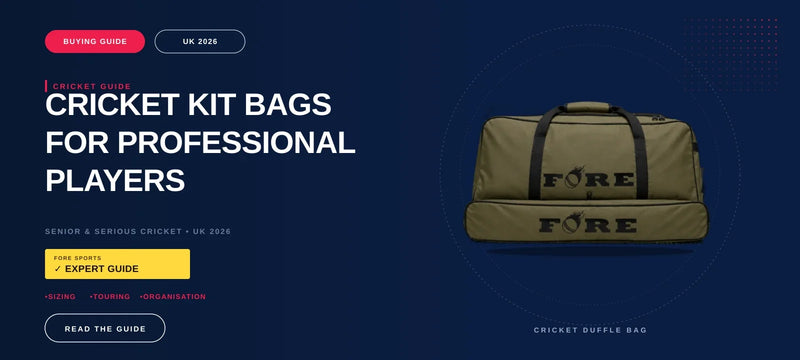
Duffle kit bag. The most popular and versatile option. A duffle carries on a padded shoulder strap or by grab handles, fits easily in a car boot, and stores neatly out of season. Ideal for club and league cricketers who drive to the ground or have a short walk. The Fore Sports Black Kit Bag is a duffle-style bag.
Wheelie kit bag. A wheeled bag with a structured base, built for carrying a heavy, complete kit without straining your back. Best if you walk a long way to the ground, use public transport, or tour regularly with a full set of gear. The trade-off is extra weight when empty and a bulkier bag to store.
Holdall or tour bag. The largest format, sized to hold one player's full touring kit plus clothing, or shared team gear. Useful for tours and overseas trips rather than weekly club use.
Backpack or junior bag. Light, compact and easy for younger players to carry themselves. Perfect for juniors and for anyone who only carries the essentials to training.
For most adult club cricketers, a well-built duffle hits the sweet spot of capacity, comfort and value. Step up to a wheelie only if your kit is genuinely heavy or your walk to the ground is long.
Key features to look for in a kit bag
Once you have a format in mind, judge any cricket kit bag on the points below.
Durability and materials
Durability starts with the fabric. Cricket bags are usually made from polyester or nylon, and the number to look for is the denier rating, written as 600D, 1200D, 1680D and so on. Higher denier means a thicker, tougher weave. Around 600D is fine for recreational use, while heavier ratings resist abrasion better and suit players who use their bag hard.
Construction matters as much as the fabric. Look for double-stitched seams at high-stress points, reinforced handle and strap attachments, and a tough base. Zips are a common failure point, so favour heavy-duty zips with strong, easy-to-grip pulls. On a wheelie bag, check the wheels and the wheel housing, as cheap wheels are the first thing to break.
Size and capacity
A bag that is too small is frustrating; a bag that is too big is heavy and awkward. Match the size to your kit.
- Junior players generally need a smaller bag, roughly 28 to 32 inches long or around 50 litres, enough for a junior bat, pads, gloves and a few accessories.
- Senior and club players carrying two or more bats plus full protective gear should look at bags from around 36 inches upwards.
- Touring or team use calls for the largest holdall and wheelie options, designed to swallow a complete kit with room for clothing.
If a bag lists capacity in litres, use it as a guide. A typical club cricketer's kit fits comfortably in a mid-sized bag without needing the biggest option on the shelf.
Compartments and organisation
Organisation is where a cricket-specific bag beats a generic holdall. The features worth having:
- A large main compartment that takes a full-size bat alongside pads, helmet and gloves.
- A bat sleeve or padded section so the bat is held securely and not knocking into other gear.
- A ventilated shoe or boot pocket, kept separate so muddy spikes do not mark your clothing.
- Side and end pockets for cricket balls, sun cream, a water bottle, your scorebook and valuables.
- A wet or dry section for damp clothing and used kit after a rain-affected match.
Good organisation is not a luxury. It is the difference between a tidy two-minute pack and a scramble.
Weatherproofing
In British cricket, weatherproofing is essential rather than optional. Look for a water-resistant outer fabric that stops light rain and damp from soaking through to your gear. A reinforced or slightly raised base is just as important, because kit bags spend most of their life sitting on wet grass, damp boundary edges and puddled changing-room floors.
Be clear on the terms. Water-resistant fabric handles rain, spray and damp ground, which covers the vast majority of match days. Fully waterproof is rare in cricket bags and usually unnecessary. For a typical British season, a water-resistant bag with a sturdy base is exactly what you want. For prolonged downpours, simply cover the bag or move it under shelter.
Carry comfort
A loaded cricket kit bag is heavy, so how you carry it matters. A wide, well-padded and adjustable shoulder strap spreads the load on longer walks from the car park to the pavilion. Dual grab handles give you a quicker second option for loading and short carries. Also check the weight of the bag when empty, especially with wheelie bags, since a heavy empty bag eats into your useful capacity.
Why choose a black kit bag?
Colour is partly personal taste, but a black kit bag has practical advantages that explain why it is the default choice for so many serious cricketers.
- It hides dirt and stains. Cricket bags live on grass, mud and dressing-room floors. Bright colours show every grass stain and scuff within weeks. A black kit bag still looks presentable after a full season of hard use.
- It looks professional. An all-black finish is sharp and understated, and it suits any club colours without clashing. Whether you are at the academy, league cricket or club nets, a black bag looks the part.
- It is timeless. Trends in kit colours change; black does not. A black bag stays looking current for years and tends to hold its appeal if you ever pass it on.
- Wear shows less. Minor scuffs, fading and marks are far less obvious on black than on lighter fabrics, so the bag looks newer for longer.
One honest caveat: black absorbs more heat in direct sun, so avoid leaving a black bag full of gear baking in a hot car for long periods. It is a minor point, and for the realities of a British season it rarely matters, but it is worth knowing.
How to choose your ideal cricket kit bag
Pull the decision together by answering three questions.
1. How much kit do you carry? A junior or a minimalist who carries the basics is well served by a compact bag or backpack. A club cricketer with a full protective kit needs a mid-sized to large bag. A player carrying multiple bats and touring gear needs the largest option.
2. How do you get to the ground? If you drive and the walk to the pavilion is short, a duffle is comfortable and convenient. If you walk a long way, rely on public transport, or your loaded kit is genuinely heavy, a wheelie bag will save your back.
3. What is your budget? Spend in proportion to how much you play. An occasional or junior player does not need a premium touring bag. A regular league cricketer should prioritise build quality, weatherproofing and a strong base, because that bag will be used hard every week.
A simple shortcut: most adult club cricketers who drive to matches are best served by a durable, weatherproof, mid-to-large black duffle kit bag. It covers the widest range of situations without overspending or overpacking.
For a wider look at brands and how UK retailers compare, see our companion guide, Top 10 Best Cricket Kit Bag Brands in the United Kingdom.
Top recommended cricket kit bags
Here are our picks from the Fore Sports cricket kit bag range, matched to different players. Prices are correct at the time of writing and may change, so check the product pages for the latest.
Best all-rounder: Cricket Kit Bag (Black)
Our top recommendation for most club cricketers is the Black Cricket Kit Bag. It is built from premium water-resistant fabric that stands up to British weather, with a reinforced base that sits flat on wet grass and dressing-room floors. Heavy-duty stitching at every stress point means the handles, straps and seams hold up under the weight of a full senior kit.
Inside, the spacious main compartment takes a full-size bat, batting pads, a helmet and gloves with room to spare, while smart side pockets handle balls, sun cream, a water bottle or your scorebook. A wide padded shoulder strap and dual grab handles give you two comfortable ways to carry it. The sleek all-black finish suits any team kit. At its current price it is an easy choice for league and serious club players who want durability without paying touring-bag money.
Best for a full senior or touring kit: Large Black Kit Bag (105 x 45 x 45 cm)
If you carry multiple bats, full protective gear and clothing, or you tour regularly, size up to the large Black Cricket Kit Bag (105 x 45 x 45 cm). The extra capacity comfortably handles a complete kit with space left over, making it the better fit for players who need to carry everything in one bag.
Best compact option: Medium Black Kit Bag (73 x 38 x 37 cm)
For players who carry a streamlined kit, or who want something easier to store and lift, the medium Black Cricket Kit Bag (73 x 38 x 37 cm) keeps the same durable, weather-resistant build in a more manageable size. A strong pick for training-focused cricketers and tidy packers.
Best for juniors: Junior Cricket Bag
Younger players need a bag they can carry themselves. The Junior Cricket Bag is light and compact, sized for a junior bat, pads, gloves and the essentials, and priced so it is no great loss when your child outgrows it.
Prefer a different colour? The same kit bags are available in blue, green and red across the full cricket kit bags collection, though black remains the most practical choice for hard, regular use.
How to pack a cricket kit bag efficiently
A well-packed bag protects your gear, balances the load and makes match day calmer. Use this order:
- Bat along the base. Lay your bat flat in its sleeve or along the bottom of the main compartment so it is protected and not free to knock against other items.
- Pads flat against the sides. Stand or lay batting pads against the bag walls. They add structure and shield softer gear.
- Helmet in a protected spot. Place the helmet where it will not be crushed, ideally in a dedicated section or cushioned by clothing.
- Soft items as padding. Gloves, clothing and a towel fill gaps and stop everything shifting in transit.
- Boots in the vented pocket. Keep cricket shoes in the separate ventilated compartment so mud and odour stay away from clean kit.
- Accessories in side pockets. Balls, sun cream, grip tape, a water bottle and valuables go in the outer and end pockets, with anything you need quickly kept easy to reach.4
Two rules: distribute weight evenly so the bag is comfortable to carry, and resist overpacking. A bag stuffed past its capacity strains the zips and seams that you bought it for.
Care and maintenance tips
A cricket kit bag lasts far longer with a little upkeep.
- Empty it after every match. Damp kit left inside causes odour and can damage the lining over time.
- Air it out. If the bag or its contents got wet, open every compartment and let it dry fully before storing. Never put a damp bag away.
- Spot clean, do not soak. Wipe the outer fabric with a damp cloth and mild soap. Avoid machine washing a large kit bag, as it can damage padding, structure and water-resistant coatings.
- Check the moving parts. Give zips, handles, straps and any wheels a quick look now and then. Catching a loose stitch early prevents a failure mid-season.
- Store it dry off-season. Keep the bag somewhere dry rather than a damp garage or loft corner. Loosely stuffing it with paper helps it hold shape.
- Re-proof if needed. If water resistance fades after heavy use, a spray-on fabric proofer can restore some protection.
Frequently asked questions
Q: What size kit bag do I need?
Match the size to your kit and player level. Junior players are well served by a smaller bag, roughly 28 to 32 inches or around 50 litres. Senior and club cricketers carrying two or more bats plus full protective gear should look at bags from about 36 inches upwards. Touring players and teams need the largest holdall or wheelie options. When in doubt, size to your current kit rather than buying the biggest bag available.
Q: Are weatherproof kit bags worth it?
For cricket in the UK, yes. A water-resistant kit bag with a sturdy, reinforced base protects your gear from rain, spray and the damp grass and floors that bags constantly sit on. Given how much a full kit costs, paying a little more for proper weatherproofing is straightforward value. You rarely need a fully waterproof bag; a good water-resistant one covers almost every match day.
Q: How do I pack a cricket kit bag efficiently?
Pack heavy and long items first, with the bat flat along the base and pads against the sides for structure. Protect the helmet, use gloves and clothing as padding to fill gaps, and keep boots in the separate ventilated pocket. Put accessories in the side pockets, with anything you need quickly within easy reach. Distribute weight evenly and avoid overpacking.
Q: What is the difference between a duffle and a wheelie kit bag?
A duffle carries on a shoulder strap or grab handles and is lighter, easier to store and ideal if you drive to the ground. A wheelie has a structured base and wheels for moving a heavy kit without straining your back, which suits long walks, public transport and touring. It is heavier when empty and bulkier to store.
Q: How long should a cricket kit bag last?
A well-made kit bag that is used sensibly and cared for should last several seasons. Durability comes down to fabric quality, stitching at stress points and the strength of zips and the base. Emptying and airing the bag after matches and storing it dry off-season makes a real difference to its lifespan.
Q: Can I use a cricket kit bag for other sports?
Yes. A spacious, durable duffle works well as a general sports or gym bag, and the separate compartments are handy for any sport with boots and protective gear. A black kit bag is especially versatile, since the understated look is not tied to one sport.
Conclusion
The right cricket kit bag is one of the most practical buys you will make: it protects expensive gear, keeps match day organised and, chosen well, lasts for years. Focus on durable materials, a weather-resistant build with a strong base, sensible size and proper compartments. A black kit bag adds the practical bonus of hiding dirt and wear while looking professional with any team kit.
For most club and league cricketers, a tough, weatherproof black duffle is the ideal choice, and the Fore Sports Black Cricket Kit Bag is built to do exactly that job, season after season. Browse the full cricket kit bags collection to find the size that fits your gear, and get your kit sorted before your next match.